
(Major spoiler warning for the entire movie)

“immigrant stories are ghost stories are multiverse stories and in multiverse stories all of your ghosts inhabit your body simultaneously…”
Migration is always a traumatic quantum branching. It’s something we’ve always known, though not necessarily in those words. We palpably feel ourselves torn from one universe and thrust into another, as a result of that one essential choice. We see the unchosen universes and unlived lives trailing behind us as we go. What if I had stayed? If I’d never realised that leaving was an option? What if I’d never found my way here?
When you make a choice so cataclysmic, these questions haunt you for good. It is an inflexion point not only for the person, but for the genealogy, forever splintered by what you have done. And this new splinter of the family is refracted in a new direction — like a light ray passing across the gravitational lens of a black hole, to places unknown.
Yet herein lies the contradiction: When you relocate to a place where you know nothing and nothing knows you, you become synonymous to your history. Holding onto everything you have always been is synonymous to survival. Systematising the universe around inherited rubrics. Trying to make it make sense.
There is only one universe, one lifetime — and that is the only one that matters.
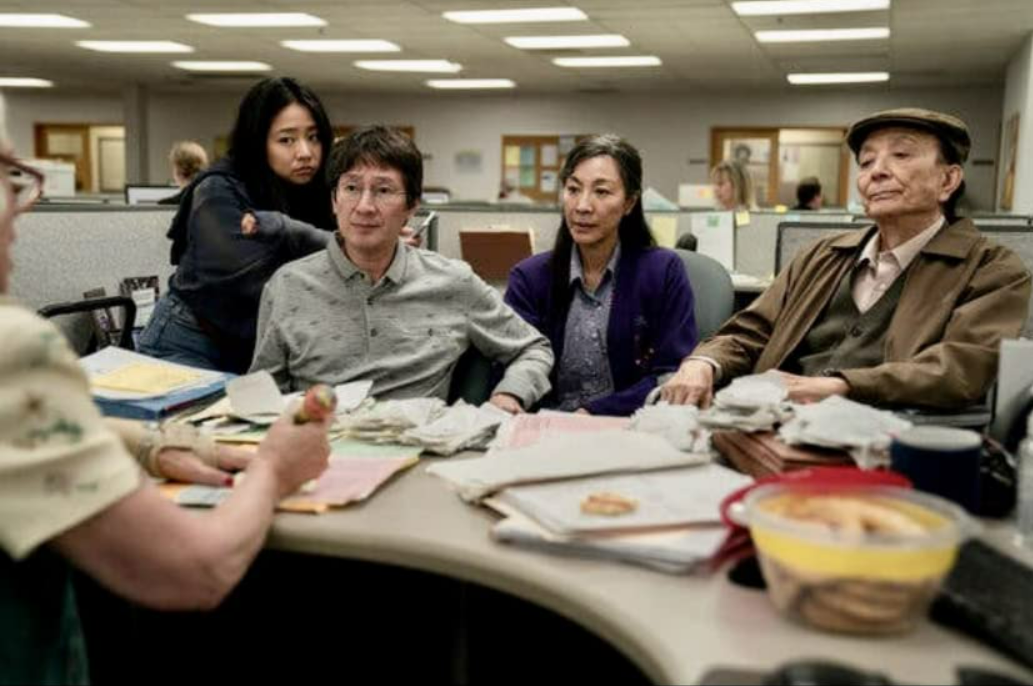
Everything Everywhere All At Once begins in such a singular lifetime. The protagonist Evelyn is a migrant whose family lives at the turbulence of tradition and chaos, history and future. Her status quo is structure, mediocrity, selfish survivalism— a defence mechanism against a strange world, in which she must leave all potential universes unvisited, except for her own.
But her daughter Joy has a different trajectory. She is of this multitudinous new world. She can chase every future that her parents could not. Evelyn cannot understand her: she gets tattoos, she has a girlfriend, she lives her life how she wants.
These are worlds Evelyn has seen, and has rejected — and now she rejects them in her daughter, too. And so begins the central conflict of this film.
A swirling bagel of trauma

The cultural inheritance of the migrant, more often than not, includes invisible cycles of hurt. We see how Evelyn’s father’s rejection of her one choice to leave home is mirrored in Evelyn’s rejection of her daughter’s individuality — a cyclic trauma, carved into their lives as aggressively as Jamie Lee Curtis’ “unloveable” auditor scrawls a black circle on her receipt.
Evelyn accepts this cycle of violence and makes it her own. But then Joy is also caught up in that swirling turbulence of trauma, with a clear awareness of what life might be without it — like Sisyphus, the chance of freedom always slipping out of her grasp. Why does family keep reeling her back in, even when she longs and hurts to break away? Why do the cycles of intergenerational trauma bear such a gravitational pull? No matter where she goes and which universe she inhabits, it seems, that vicious circle of pain inevitably finds her there.
It’s no wonder, then, that when Joy attains multiversal omniscience as Jobu Tupaki, all she wants is to make an equally inevitable, swirling everything bagel with literally everything on it, so that it collapses under its own weight and ends it all.
Probability clouds
“So when the photons pass through the two slits without an active observer we get an interference pattern suggesting they are waves… Through the
simple act of observing the experiment, the photons are now behaving as if they are distinct particles…”
It is a time-tested device, for works of fiction to render landscapes as allegories for the protagonists’ internal journey. This is Lawrence of Arabia’s desert, Moby-Dick’s ocean, Heart of Darkness’ equatorial forests— a colonial conceit to be sure, the traversal of which is framed as a journey through the soul.
In Everything Everywhere All At Once, that conceit is exploded and reconstructed: there is not a landscape allegory, so much as a metaphysical one, and this film finds its tone in the Many Worlds Interpretation.
The Many Worlds Interpretation (MWI) of quantum mechanics was posited in 1957 by physicist Hugh Everett, as a way of reconciling our deterministic existence — the fact that we are discrete things — with quantum indeterminacy, the idea that everything is made up of particles that exist as probabilistic clouds, possible locations, until they are observed, upon which they collapse to a single definite location.
Everett suggests that, rather than collapsing through observation, every probabilistic event actually creates multiple diverging universes, one for every possible outcome — like an infinitely branching tree. In one universe, an atom decays and kills a cat. In another universe, it does not, and the cat lives. In effect, every possible universe exists, somewhere upon the quantum tree.

This is the style of multiverse that Everything Everywhere dives into at a neck-breaking pace. Stories that explore the idea of alternate universes where different choices are made are not that new: from Robert Frost’s The Road Not Taken, to Sony’s Into the Spiderverse, a wealth of media across time and space entertains the question of how lives might have played out differently if different choices had been made.
Everything Everywhere harnesses this device to tell a particular story of unvisited futures — the ones that haunt the people who make the choice to migrate, and splinter families and legacies for good.
But one piece of multiversal literature is far more interwoven with Everything Everywhere’s many-worlds cosmology than any of the ones mentioned above: the Avataṃsaka Sūtra.
Worlds within worlds
The Avataṃsaka Sūtra is a sacred text of Mahāyāna Buddhism, and one of its most influential. This is the most widespread religion across East Asia, with about 360 million practitioners as of 2013 (Source: An Introduction to Buddhism: Teachings, History and Practices). Among its teachings, the Sūtra conceives of a multitude of universes, as numerous as motes of dust, and our souls being mirrored across these multiple universes, each a facet of the same self. That sounds familiar, doesn’t it?
Specifically, however, the Avataṃsaka Sūtra describes how all things are fundamentally empty, and therefore all universes are contained within all others. Not only are universes as many as motes of dust, but all motes of dust themselves contain all possible universes. (This idea is reminiscent of some aspects of String Theory, but that’s for future discussion elsewhere.)
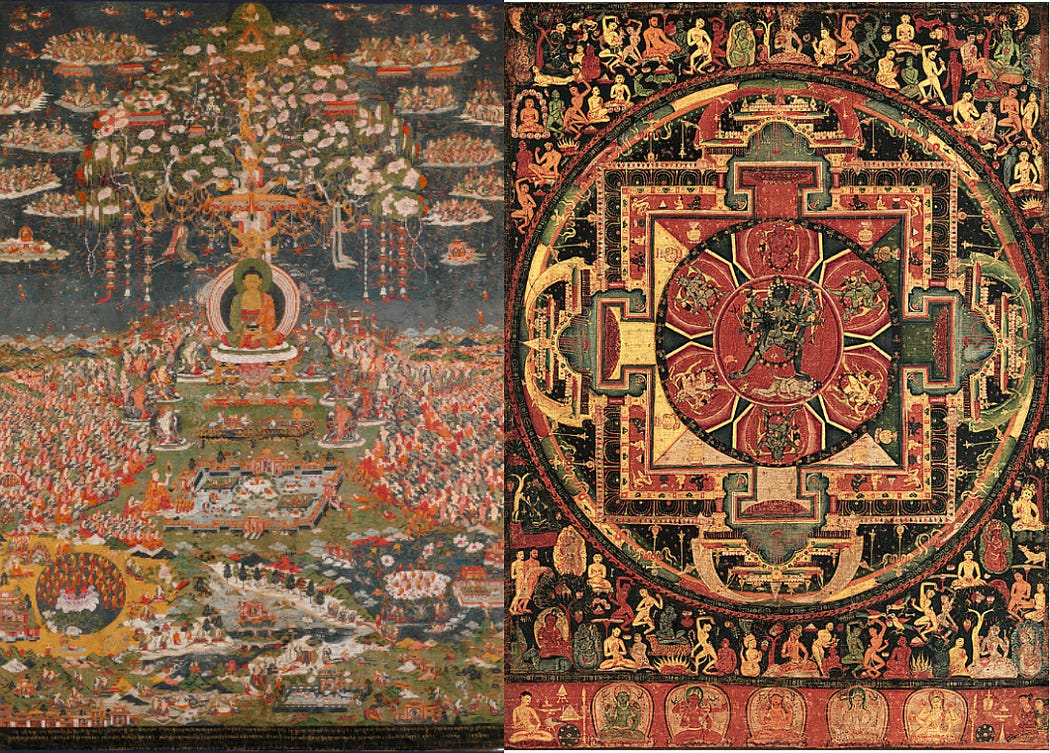
According to the Sūtra, other universes are accessed not by travel but by consciousness. Only through meditation can one awaken to other realms and perceive all the reflections of the self in all universes:
“Having understood that the world’s true nature is mind, you display bodies of your own in harmony with the world. Having realized that this world is like a dream, and that all Buddhas are like mere reflections, that all principles [dharma] are like an echo, you move unimpeded in the world” — Avataṃsaka Sūtra, translated by Luis Gómez, 1967 (Source: Mahayana Buddhism: The Doctrinal Foundations, 2009)
Such an awakening to the universe is often signified by the opening of a spiritual third eye, which perceives and penetrates far beyond physical sight. As you may recall, the film is anchored by the visual motif of open eyes.
Eyes within eyes
Mahāyāna Buddhism isn’t the only East Asian religious tradition at the beating heart of this film. Enter: the Daoist concept of Yin and Yang.
The terms “Yin’’ and “Yang” often conjure a particular image: the Taiji symbol. It’s generally also well-known that these terms signify a core philosophical concept in Daoism: that positive and negative forces tend to exist in complementary, interdependent pairs — each the other’s inverse, and yet profoundly alike to it.
Just as Yang is the energy that thrusts a ball into the air, Yin is the gravity that returns it to the ground. Just as Yang is the light that shines on the eastern side of the hill, Yin is the shadow it casts on the western side — and as time passes, their positions cycle and invert, so the dark face becomes bright, and the bright face dark.

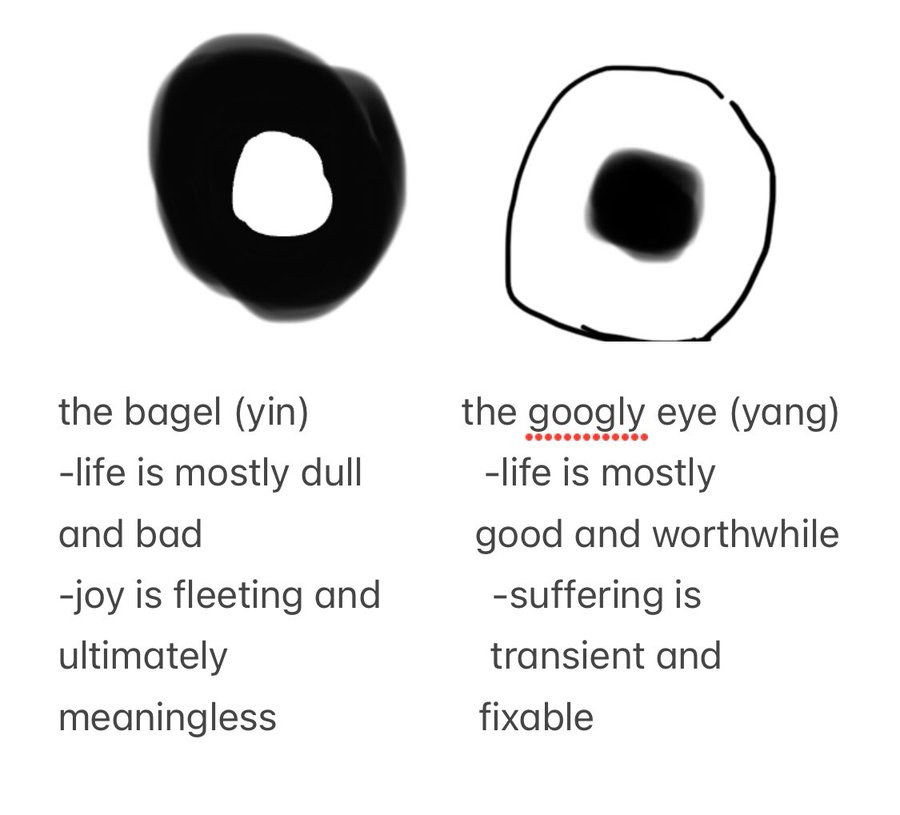
Everything Everywhere certainly takes this concept to its heart, and to signify the core duality of the film, it reconstitutes the Taiji symbol in the form of two objects that utterly dispense with any highbrow pretension: a bagel and a googly eye. The relationship of these symbols with Yin and Yang is aptly depicted by Twitter user HAEDRAULICS, shown above.
The Everything Bagel and the googly eye do resemble the visual portions of the Taiji symbol separated, but Everything Everywhere is anything but surface deep.
The Everything Bagel is also a black hole. That much is clear from how it seems to pull in and spaghettify everything that approaches it. But it’s not just a black hole: it is a model of a ring singularity, a Kerr black hole. Formed when a rotating star collapses on its weight, these rotating black holes have curious properties — one being that they theoretically intersect two universes and multiple points in time simultaneously.
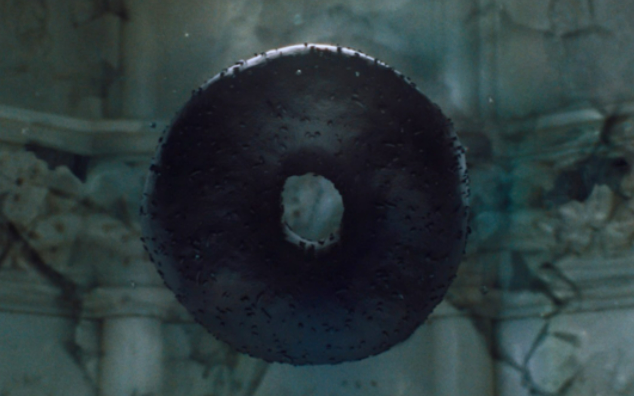
The bagel is, on its surface, inevitability: it is where everything goes to end. But it is a rotating, circular bagel: it is the gravitational pull of intergenerational cycles of trauma, short-sighted structure perpetuating itself by its own inertia, on which Jobu will soon put everything that exists. It is everything, and yet it is a zero — nihil, nothing.
Nihilism is the philosophy of meaninglessness — it is the notion that no human moral, meaning or truth has any fundamental basis in the universe. To such a worldview, “nothing matters,” except destruction. Like the universe unwinding to its heat death, Nietzche posited nihilism would soon consume society and possess all with malaise and hopelessness.
In a way, we already see it happening — the Western project of capitalism has crept into the heart of morality, initiating the death of empathy, asking us to act selfishly and short-sightedly and fuel the destruction of life on Earth.
Jobu Tupaki’s black hole, an everything bagel of universe-rending proportions, is that very short-sighted nihilism taken to its logical extreme. She will put everything on it because she can, even if it results in the end of the universe. Because who wants to exist in a universe doomed to futility? Most of us who are aware of the possible annihilation of everything — by death, by climate crisis, by the random happenstance of the cosmos—have known the allure of Nietzche’s void. The only answer, according to late-stage capitalism, is to keep having more — to keep throwing more into that bottomless hole.
Aptly, the Everything Bagel is also Jobu Tupaki’s third eye — this much is indicated by the fact she wears it as a crown and her cult draws it on their foreheads. When Jobu’s consciousness opens to the multiverse, she sees inevitability: everything converging in futility, determinism and cycles, like the ones that her mother in every universe wrapped her within.
Buddhism also embraces nothing. All is empty; nothing inherently exists; nirvana is “a place of nothingness.” And this other face of nihilism almost seems to place an eye of white in a sea of dark. If there is no preordained basis of meaning, then we are free to make that meaning ourselves.
Likewise, unlike a point black hole, there is mathematically theorised to be an escape path from a Kerr black hole — the singularity does not inevitably pull everything into it. The hole in the circle is its escape clause —just as the white dot is the Yang within the Yin.
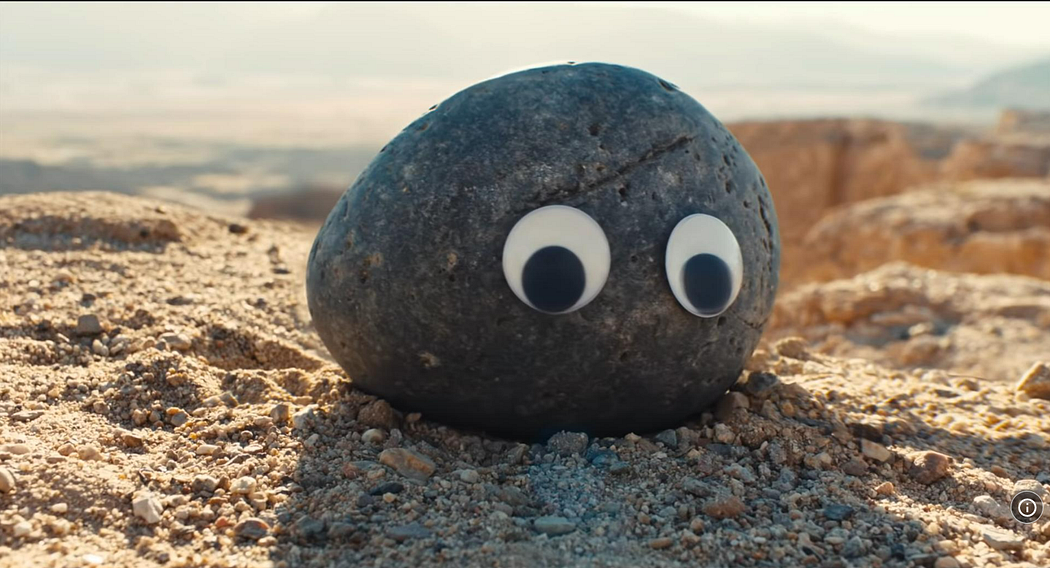
How about the googly eyes? Googly eyes are a comedic prop: they’re meant to look silly. It’s no mistake the most gripping moments of the film are often also moments of absolute hilarity: a rock with eyes rolling down a hill, a woman with hot dog fingers stroking her partner’s face with her foot, a man controlled by a raccoon pulling his hair.
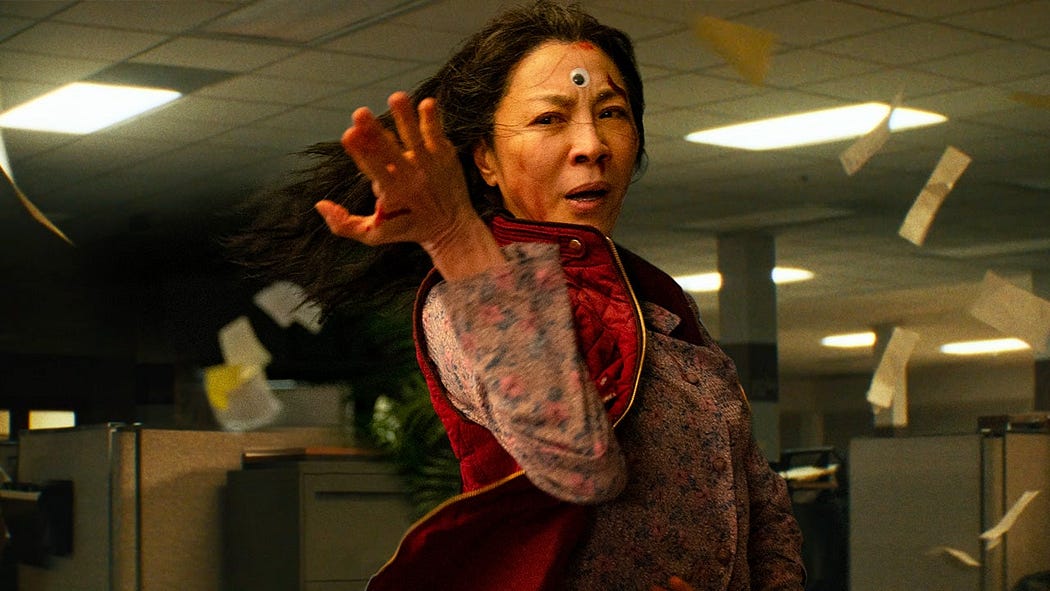
This is a movie that revels in its postmodern absurdity. Just as Evelyn pastes a googly eye — her third eye — on her forehead, she awakens to the multiverse to see in the nothingness not inevitability, but infinite choice: an endlessly generous universe in which we may cast whatever meaning we desire.
Films within films
The true brilliance of Everything Everywhere All At Once’s multiverse allegory is in its delivery through the parallel metaphor of its own medium.
Within a limited timespan and two-dimensional bounds, how does a movie honour vast and timeless themes? Every work of fiction must navigate its own solution to this problem, and Everything’s answer is worth especial examination.
The film begins as a deceptively contained drama. It establishes a status quo, introduces conflict through an inciting incident, then sends the protagonist on a journey.
That’s where the traditionality ends. Everything brings a sledgehammer to the Fourth Wall — and boy, is it a spectacular demolition.
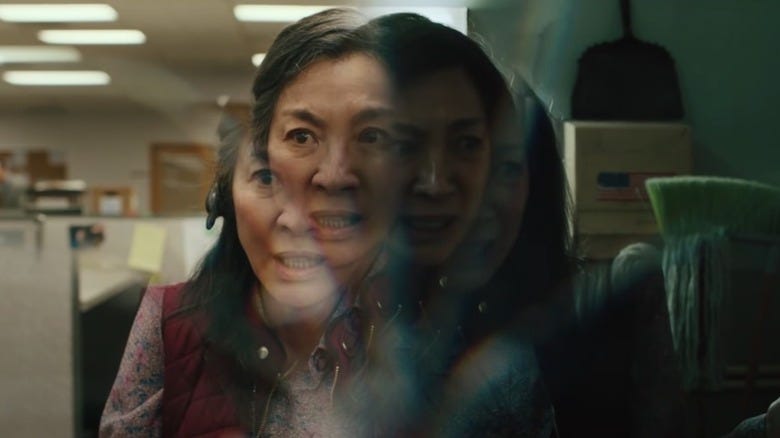
Mirrors and screens are omnipresent throughout Everything Everywhere, and are often the windows to other universes. We see the religious ties of mirrors in the Avataṃsaka Sūtra, where it is said that the self is “reflected” across incarnations, multiplied across all universes.
While we are watching a film, the cinema screen also becomes a mirror of light — and a surrogate for a universe. When a character peers into a different universe, it is often mediated by such a mirror or window: the round dresser mirror in which we see a scene from the past of the family at karaoke, the TV screen that Evelyn gazes longingly at as a period drama plays, the auditor’s mirror into which Evelyn looks when she first verse-jumps, the mobile screen through which the tree of the multiverse can be seen. These filmic universes are embedded within the film’s universe, setting it up as a reality in which smaller realities can be found.
To paint that metaphor further, the story positions other filmic worlds in parallel with itself, a single universe among many. Some of the alternate universes are quite literally re-enactments of other movies — The Matrix, 2001: A Space Odyssey, Ratatouille. But of particular note is the reference to Michelle Yeoh’s— the actress playing Evelyn’s — filmography. The “kung fu universe” is very likely a reference to her history of starring in Hong Kong martial arts films; that segment references hallmark tropes of the genre, such as the protagonist unlocking her full potential through arduous training and an inner awakening.
Not only that, but some of the shots from the movie star universe were taken from real press footage of Michelle Yeoh, including one from the red carpet premiere of Crazy Rich Asians. All at once, Evelyn is Michelle Yeoh and every person Yeoh has portrayed — a thousand splinters of the soul, as signified by the cracking of the mirror.
But the film does not stop there: it then steps outside of itself. We probably remember the moment when the credits rolled in the middle of the film, and we (most likely) experienced a moment of radical displacement. We understand what a credits roll means: it means the film is over. We’re thrown out of the movie, awakened back to an awareness that we’re watching a film. In film studies this is called “media-awareness” … kind of like the opening of the third eye, to the universes around us.
In the same moment Evelyn has her awakening, the suspension of disbelief is shattered — and then reconstructed outside the movie. In that moment, our universe — the audience’s universe — is absorbed into that multiverse — and the film becomes a smaller universe within our own, itself containing universes of its own.
Bridging the universal divide
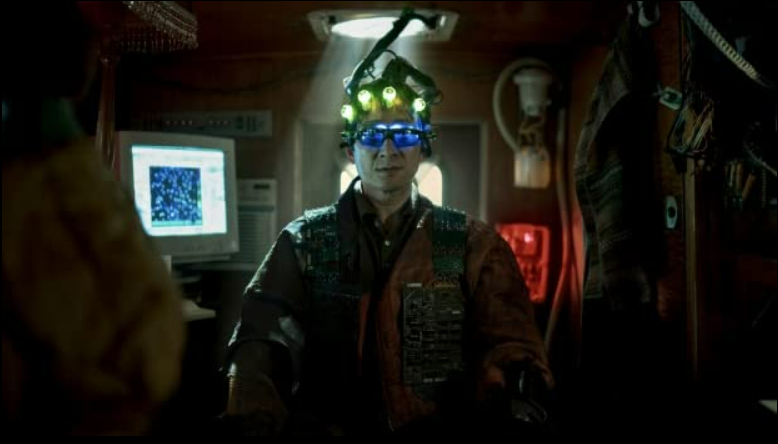
Beyond demonstrating the disarray of the multiverse, what do these meta-references truly deliver?
In Everything Everywhere, the family at the centre of the story is profoundly disjointed. Different worlds and genres signify empathy divides: each member is living in a universe of their own, and their struggles to connect are embodied in their struggles to reach each other — and sometimes themselves — through layers of filmic conventions.
Dan Kwan suggests as much in his commentary:
“So, this movie is mostly about people thinking that they’re in different movies and different genres, and the kind of the confusion that can come from that.” — Daniels (Source: The New York Times)
“The family dynamic in our film was interesting because even before we get into the multiverse, they’re already in different worlds; they’re already speaking past each other.” — Dan Kwan (Source: LA Times)
Empathy, by its ur-definition, is when a person comes to embody the thoughts and feelings of another, and can “think as he thinks, understand as he understands” (Source: Lectures on the experimental psychology of the thought-processes).
At the start of Everything Everywhere All At Once, Evelyn lacks any such empathy. It’s a defence mechanism, and it is a resonant one — akin to the indifference I’ve seen my own mother learn from years of abuse. She’s serious, she’s composed, she’s a survivor and a survivalist. She tries to mould her daughter’s choices as if she were another problem to be solved, and scorns her husband’s antics as a hindrance to the running of their laundromat.
But as the story opens up into a multiversal conflict, it also introduces the mechanic of verse-jumping. We are quickly told that this is a means of transmitting powers between universes, by bridging the psychic gaps between different selves.
These other selves often exist in worlds so utterly different from the primary universe that they may as well be alien — as alien as a futuristic world to the characters of a period drama. It is essential, then, that verse-jumping involves the transmission of not only thoughts and memories, but also emotions — because this is ultimately a device that operates via empathy. Empathy is what bridges that psychic gap: the recipient must not only know what the other self knows, but also understand as they understand.
And this has implications for the film’s thesis on empathy. It’s easy to look at someone in an alike situation and say, “I know how you feel.” But a vast proportion of people around us are not so transparently similar. In fact, most people will be more different than alike— sometimes so different we cannot recognise any part of ourselves in them.
Sometimes, one is asked to understand a person who seems to be of a different universe altogether. A daughter born in a new and utterly different cultural milieu. A husband whose approach to the world is radically opposite to one’s own.
This is the challenge that the story puts Evelyn to. To become her fully-realised self, she must empathise with every other self. And that sort of empathy — it takes work. It comes at the expense of all she knows herself to be.
To profess love for a mean, frumpy auditor, to support a hibachi chef controlled by a raccoon in his hat, to admit that a meagre life with her husband at her side is truly better than an opulent life without him—difficult, ridiculous, strange circumstances where empathy is not some slip-on glove, but almost too much to ask.
And she’s had to be selfish all her life, and she’s had to cling to everything she knew — it’s what kept her alive, when she gave her old world up for her new. It’s not easy for the broken. It can be the hardest thing there is.
When Evelyn’s mind opens to the multiverse, it is not an epiphany of genius, but an arrival at a place of generosity and empathy for all her selves — the ones she admires and the ones she abhors. It’s the empathy and compassion to tell her daughter — whom she can barely comprehend anymore — that she can be anything she wants.
This happens at the climax of the film, after Evelyn and Joy battle across multiple universes at once. All at once, but briefly, they are all those selves in all bodies, straddling all genres and universes. In the laundromat. In an otherworldly hall. On a staircase at the IRS. A probability cloud of lifetimes.
But then the camera comes to rest, and everything collapses to a single place, a single point, on a parking lot, at night, in the first universe. And all Evelyn can say then is what she said at the start—“You’re getting fat. […] You only visit when you need something, and you got a tattoo, and I don’t care if it’s supposed to represent our family, you know I hate tattoos.”
She’s still flawed, small, limited Evelyn. Achieving multiversal awareness has not magically made her a perfect being: for the film to have her do so would be disingenuous and false, and demand the very failure of empathy that it rebels against. She’s still a mother who doesn’t understand her daughter, and is terrified of what waits beyond this cycle of trauma that she’s made her home.
And Joy is a daughter who doesn’t understand her mother, and is terrified of what waits beyond this cycle of trauma that has engulfed them both.
But they are bridging their incompatible universes now, and at the same time relinquishing each other to their own different worlds. They empathise with each other— flawed, messy, and more similar than different.
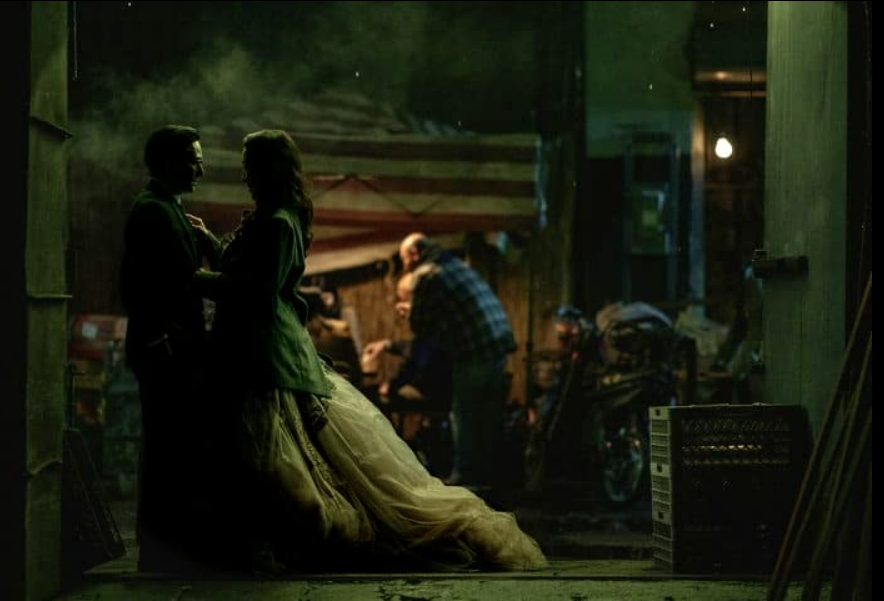
Among the reasons we consume stories and make stories of our own, one of the most pervasive — and perhaps the most transformative — is the chance that stories afford us to live the lives we don’t.
We need that space more than ever, but we need that space to be empowering, not anaesthetising. Escapism, power fantasies, wish-fulfilment — they’re all different terms for seeing oneself in a story.
We aren’t Evelyn, jumping through the multiverse to stop her daughter from destroying the universe. But we laugh, cringe, rejoice, baulk, cry when she does. Hell, I’ve just spent two days writing an essay about a movie, and if you’ve gotten this far, then you’ve found some meaning in it, too.
Isn’t that proof we can, and do, see ourselves in the lives of others— even fictional others? Isn’t that the hallmark of empathy?
A world as absurd as we are
“…for the improvisation of Jobu specifically, it’s not about saying the funniest joke; it’s not that kind of improv. It’s about being so alive that anything that you touch or hear or even just think becomes an impulse that you either choose to follow or you reject.” — Stephanie Hsu (Source: Vulture.com)
Everything Everywhere All At Once makes a clear final statement: we can do anything. But that’s not what it seems to portray. How does one reconcile the multiple universes we are haunted by with the unforgiving singularity of the lives we do live?
This is a film that draws together a whole menagerie of metaphysical schools of thought. Eyes, bagels, holes, zeroes, circles, splinters of the mind, multiple universes, realms upon realms, futility, choice, determinism, nihilism, kindness.
And this, more than anything, truly cuts to the core of the malaise that has consumed us as a species. All of it is paradoxical! None of it makes sense! Though we try to harness the universe in ever more structured systems of meaning, deriving Theories of Everything, penning discourses in ontology, the universe will always escape us.
But that’s not an indictment on existence, it can’t be — we cannot afford that. If the universe is meaningless, and nothing is inherently connected to anything else — then we must make those connections ourselves. Between you and I. Between who you are and who you cannot be. It is as Waymond says, in his own naïve way: the best we can do is to be kind, “especially when we don’t know what’s going on.”
Soft sci-fi revels in a cosmos that externalises and plays out a psychological, or societal, question. In this film, absurdity is a signifier for how little sense it makes. The googly eyes make a difference not because they are magically empowered, but because they’re silly, and silliness matters. Humour is the only way we can make sense of an absurd world. This is the gentleness towards the self that Waymond embodies: the only way to be kind is to accept self contradiction.
Throughout history, absurdist movements have answered to the breakdown of meaning. In these past three years, we’ve seen our cities shut down, our borders close, our families locked on the other side, and it often — more often than ever — feels like everything is slowly being sucked into a bagel.
Doesn’t it? Isn’t that the only way I can describe the way it feels — with an equally incomprehensible metaphor?
This is how we must live, in a universe so governed by random chance. In most versions of the universe, I do not exist. In most versions of the universe, none of us do. Existence rests upon probability and potentiality. It’s the most fundamental, consummate breakdown of meaning there is.
And Everything, Everywhere, All At Once has it all, all the ways it makes no sense.
Being a migrant, at the crosswinds of everything, makes no sense. Leaving a world where summer ends and the streets are full of people we know — for a world where none of this is true, makes no sense. The electrons and photons and quarks that make us up, existing in multiple places at once— that makes no sense.
Comedy is the celebration of nothingness. It makes light of all we cling dearly to as the foundation of self, for fear of a world without it. It shows us a world where those scaffolds of self don’t matter.
And there is meaning and catharsis to it —not having to make sense.
We are everything, everywhere, all at once: probabilistic clouds of alternate universes in singular bodies — all the people we could be in the future, the people we never became, and the people we are — connecting with others who are also everywhere, making up existence through our overlapping lifetimes.
And that doesn’t need to make sense.
Addendum
Shoutout to all the yonic and phallic imagery in this film, which seems to echo the commonness of such iconography in religions across the world. What’s a good existential film without that? The bagel, and the pairs of fingers we peer through to look at it, sure are reminiscent of vaginas, and then we’ve got hot dog fingers and mustard sauce mating rituals, butt plug trophies, and copious references to kink.
Maybe it’s because we so keenly avoid sexual subjects elsewhere, and that elsewhere they are portrayed exploitatively, that there is a cathartic liberty to seeing sexual imagery presented in such a fashion…I’m not the one to write a cogent analysis of it, maybe someone else can pick up the slack?
Leave a Reply